
Are you in the AI answer, or is your competitor?
Search stopped being ten blue links. A growing share of your buyers now read one synthesised answer and never scroll — and either you are cited in it or a rival is. We write content built for both jobs at once: quotable inside AI answers, structured for classic search. Then we track, every week, whether it worked.
What is GEO, in one paragraph
Generative engine optimisation is the work of getting your pages cited inside AI-generated answers — ChatGPT, Gemini, Perplexity, Google's AI Overviews — rather than only ranked in a list of links. It overlaps with SEO but is not the same job: a page can rank first on Google and never be quoted once, because being findable and being quotable are different properties. GEO is the second one.
Can AI engines reach you, and is what they find worth citing?
Two different problems with two different fixes — and almost every tool on the market only looks at the second. Reachability is read from your robots.txt and your rendered HTML. Citability is read from the answers themselves.
A miss stops being a percentage and becomes a page with a defect.
We ask the questions your buyers actually type, several times a week, on three engines — and record one of five outcomes each time: cited, named, absent, rival only, or no answer. Every cited URL is joined back to a crawled inventory of your own pages, so we can name the page that lost instead of handing you a dashboard that says you are invisible.
- Every figure ships with its interval and its sample count
- When two ranges overlap we say “no change we can detect” — rather than reporting noise as progress
- “No answer” is excluded, not counted as a miss — Google does not render an AI Overview for every query
- Next week's run measures whether the rewrite worked
The work, end to end
Six things that happen on every engagement — from checking whether the engines can reach you at all, through to the weekly run that says whether the rewrite landed.
Crawler access audit
We read your robots.txt crawler by crawler and check the page renders without JavaScript. A page an AI engine cannot fetch is never cited, however good the writing.
Two scores, never merged
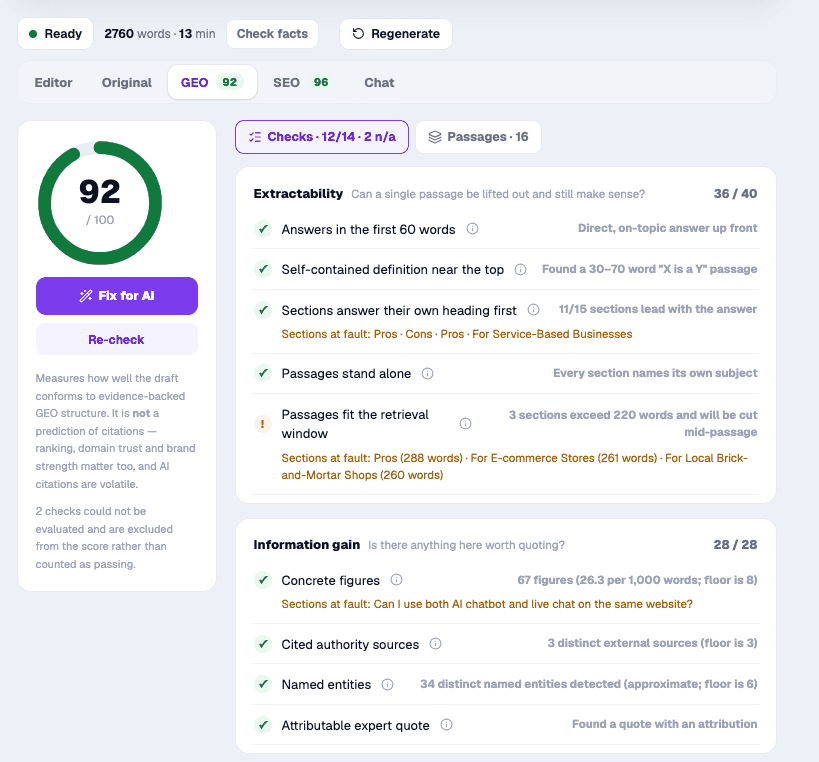
A GEO score and an SEO score, kept deliberately separate. Averaging them hides the one that is failing, which is the one you need to fix.
Built to be quoted
Self-contained passages, specific claims, real sources. The structures AI answers actually lift — not keyword density.
A critic that says no
Every draft is scored before it ships, and it will call an article unverifiable rather than publish a claim it cannot stand behind.
Publishes on a schedule
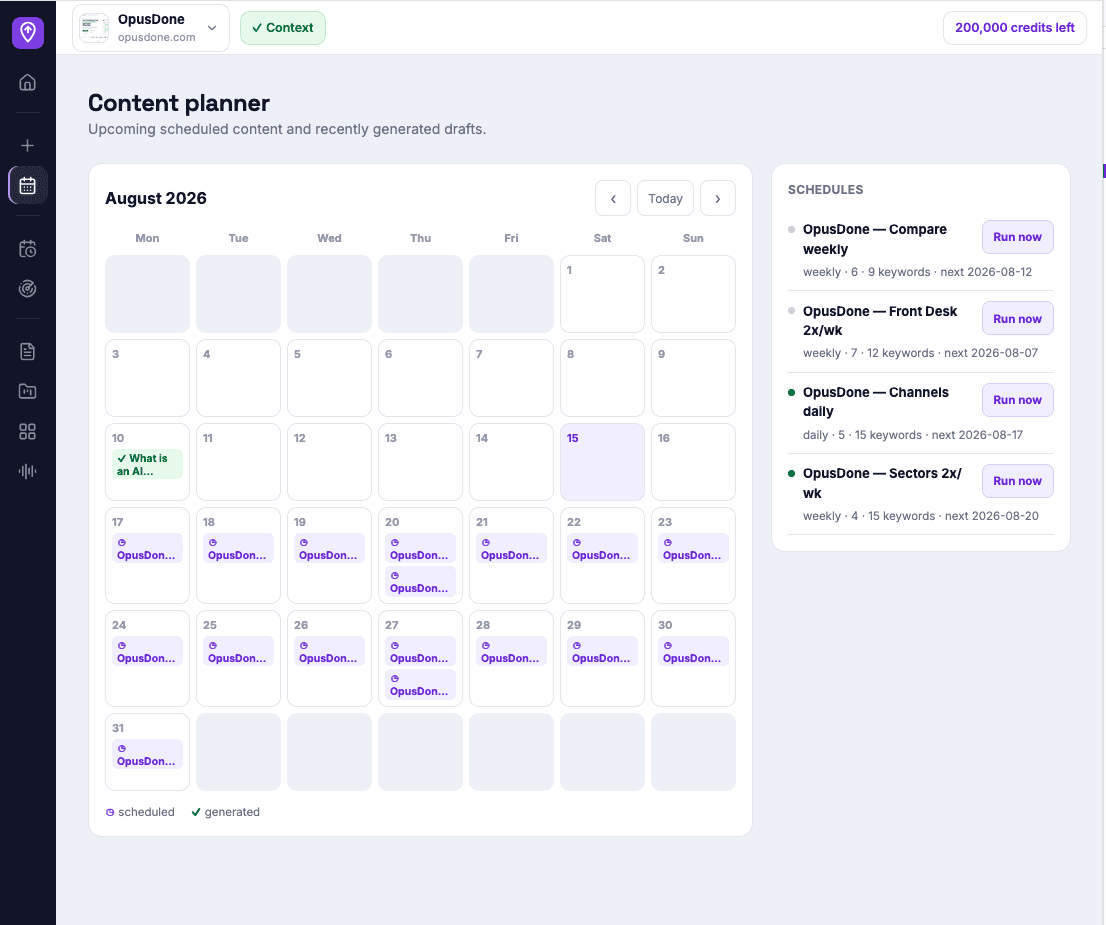
Set a cadence and a destination once. Every run researches, writes, illustrates, scores and files a finished post — gated on a minimum score.
Measured on both
Search Console for rankings, weekly visibility runs for citations. One monthly report covering both, with what to do next.
From invisible to cited
The first two steps are free and take a few minutes. You will know where you stand before you spend anything.
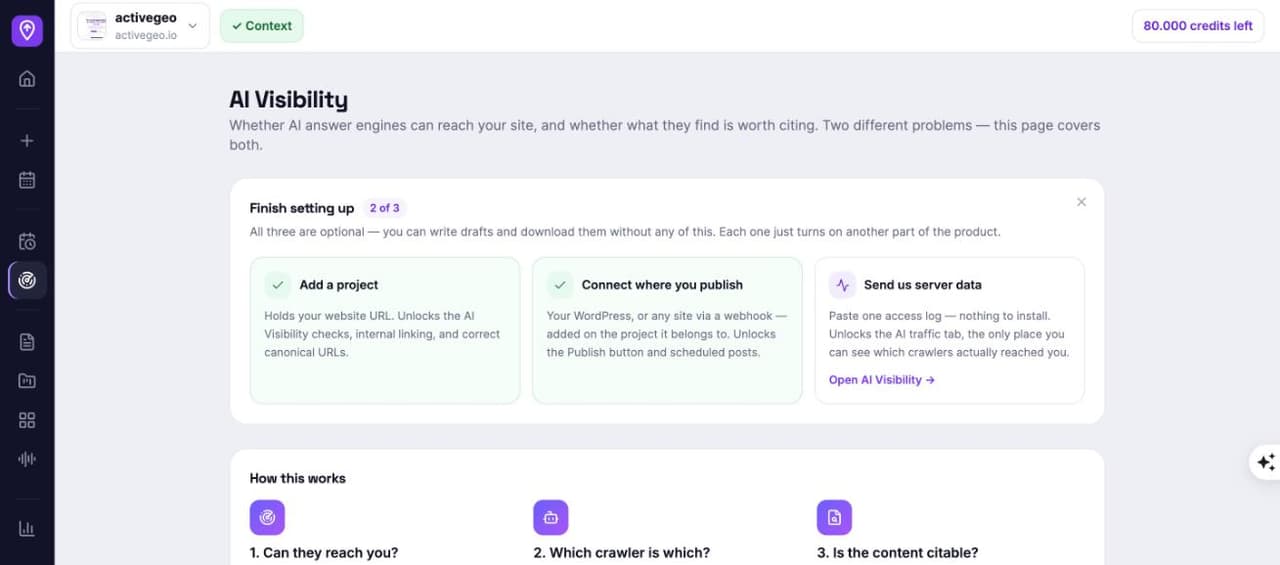
Check access
Which AI crawlers can reach you, which are blocked, and what each block costs you. Read from your robots.txt and your rendered HTML.
Baseline visibility
We run the prompts your buyers type across three engines and record who gets cited — you, or the competitors that appear instead.
Fix the pages that lost
Each miss maps to a real page. The prompt's intent picks the template, and we rewrite that page to be quotable — without losing its rankings.
Publish and re-measure
New content ships on a schedule behind a quality gate. Next week's run tells us whether the rewrite moved anything, and by how much.
Built on ActiveGeo — our own engine
Three free tools, no account needed
- AI visibility check — see whether the engines can reach you
- GEO & SEO content score — paste a URL, get both scores with every failing check named
- AI crawler verifier — confirm which bots actually fetched you, read from your own server logs
- What is GEO? — the long version, with what the evidence does and does not say
- GEO templates — the 10 formats built to be quoted
- AI visibility tracking — how we measure it, and what an add-on costs
What we will not tell you
That we can guarantee citations. Nobody can. AI answers vary run to run, the engines change their retrieval without notice, and any vendor promising a citation rate is promising something they do not control.
What we will do is measure honestly — ranges rather than ranks, sample counts on every figure, and “no change we can detect” when two ranges overlap, even when the midpoint moved. A tool that reports noise as progress is worse than no tool, and an agency that does it is worse than no agency.
Common questions about GEO
Is GEO just SEO with a new name?
No, though they overlap. SEO gets you into a ranked list; GEO gets you quoted inside a generated answer. A page can do the first perfectly and never do the second, because the properties that make a page rank and the properties that make it quotable are not the same. We work on both, and we score them separately so you can see which one is failing.
Can you guarantee we will be cited by ChatGPT?
No, and you should be sceptical of anyone who says otherwise. What we can do is remove the reasons you are not being cited — blocked crawlers, JavaScript-only pages, unquotable structure, unverifiable claims — and then measure, weekly, what changed.
Will blocking AI crawlers protect our content?
It depends entirely which crawler. Blocking a training crawler costs you nothing. Blocking a retrieval crawler removes you from that engine's answers completely. They are different bots with different names, and most robots.txt files we audit block the wrong one by accident.
How is this different from an AI writing tool?
A writing tool produces drafts. This is an audit, a rewrite programme and a measurement loop, run by people, on top of an engine we built and operate ourselves. The writing is the middle step, not the product.
How much content, and how often?
Typically 4–12 pieces a month, published on a schedule behind a minimum-score gate. Volume is a lever, not a goal — on most sites the bigger early win is rewriting pages that already rank but never get quoted.
Do you need access to our CMS?
Not necessarily. We publish straight to WordPress or a webhook if you want that, or hand over finished drafts for your team to review and publish. Drafts-first is the default until you trust the output.
Find out where you actually stand.
Send us your domain. We will run the crawler-access check and a first visibility baseline, and tell you what we see — including if the honest answer is that you do not need us yet.